
What Is Phase Cancellation? How Vocal Removal Works
What Is Phase Cancellation? How Vocal Removal Works
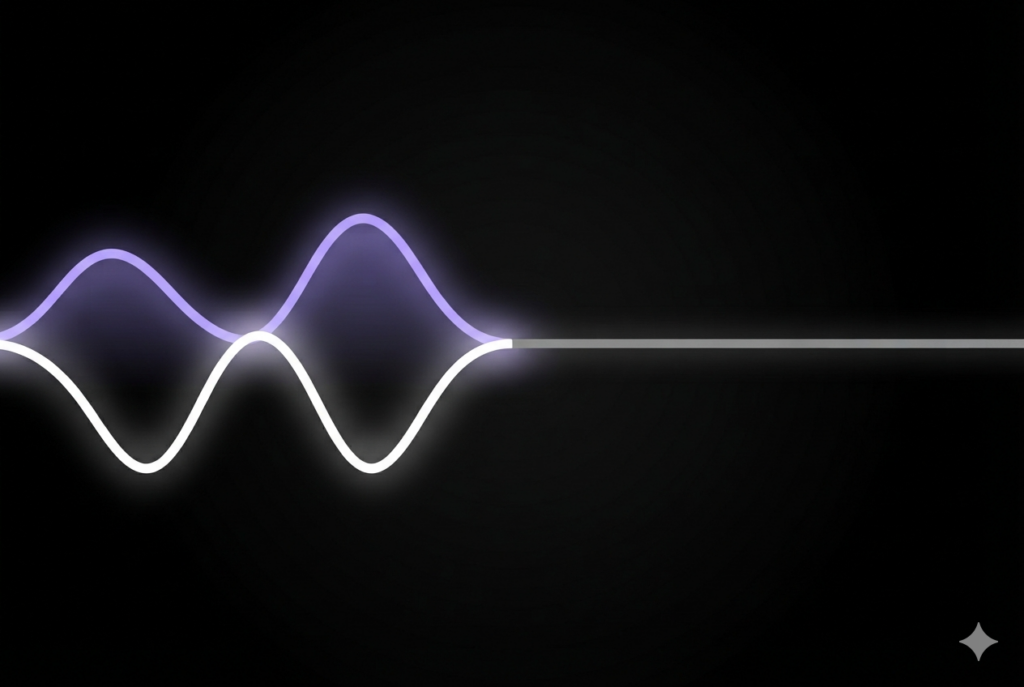
Phase cancellation is the phenomenon where two identical audio signals that are opposite in polarity cancel each other out to silence. It's the mathematical principle behind browser-based vocal removal tools.
Phase cancellation is one of the most important concepts in audio engineering — it explains why two audio signals can add together and produce silence, why some microphone setups sound thin and hollow, and how browser-based vocal removal tools work without AI. Understanding it makes you a better editor and helps you use tools like sound-goods Vocal Remover more effectively.
What is phase in audio?
Every audio signal is a waveform — a pattern of air pressure changes over time. The phase of a signal describes where it is in its cycle at a given moment. Two identical waveforms that are perfectly synchronized are said to be in phase. When they're misaligned by half a cycle (180 degrees), they are out of phase.
What happens when out-of-phase signals combine?
When you add two identical but inverted (180° out of phase) signals together, the peaks of one align with the troughs of the other. Each positive value cancels its corresponding negative value. The mathematical result is zero — silence. This is phase cancellation.
How vocal removal uses phase cancellation
In a standard professionally mixed stereo recording, the lead vocal is placed at the center of the stereo field — it appears at identical amplitude in both the left and right channels. Instruments and other elements are typically panned left or right, making them different between channels.
The vocal removal algorithm:
- Take the left channel: L
- Take the right channel: R
- Compute the difference: L − R (or equivalently: L + (−R))
- Since the vocal appears identically in L and R, it cancels:
vocal − vocal = 0 - Instruments panned left or right are different in L and R, so they survive the subtraction
The result is the instrumental track. The vocal isolation track is the original mixed with the instrumental subtracted.
Why it doesn't work perfectly on all songs
Phase cancellation vocal removal works best when the vocal is truly centered and instruments are truly panned. Modern production often violates these assumptions:
| Production element | Effect on cancellation |
|---|---|
| Lead vocal — center panned (standard) | Cancels cleanly |
| Vocal with stereo reverb | Partially survives — reverb tails are in both channels differently |
| Vocal with stereo widener plugin | Partially survives — widener spreads signal differently L/R |
| Bass guitar / kick drum — center panned | Also cancels — causes hollow sound |
| Guitar — hard panned L or R | Survives in instrumental |
| Mono source file | Everything cancels — produces silence |
Try phase cancellation vocal removal — instant, free
Works in your browser. No upload. Both instrumental and vocal stem generated simultaneously.
Open Vocal Remover →Phase cancellation vs. AI stem separation
Phase cancellation (used by sound-goods): mathematical operation running in milliseconds. Works on the stereo field geometry. Free, instant, private. Limited by stereo field assumptions.
AI stem separation (LALAL.AI, Spleeter, Demucs): trained neural networks that have learned to identify vocal timbre, pitch, and spectral characteristics independent of stereo position. Works on mono files. More accurate on complex modern productions. Requires server upload and processing time.
Phase cancellation in audio engineering (beyond vocal removal)
Phase cancellation is a broader phenomenon that audio engineers manage in many contexts:
- Microphone placement — two mics on the same source with slightly different distances create comb filtering (frequency-selective cancellation), causing a thin or hollow sound
- Speaker systems — subwoofers and full-range speakers summing out of phase cause bass cancellation
- Mono compatibility — stereo recordings that use heavy M/S processing or stereo widening can collapse to silence or thin sound when played in mono
- Side-channel in M/S recording — the S (side) channel is the L−R difference signal, which is exactly what vocal removal computes
Leave a Reply